Get Started With the BOK Step-by-Step-Guide
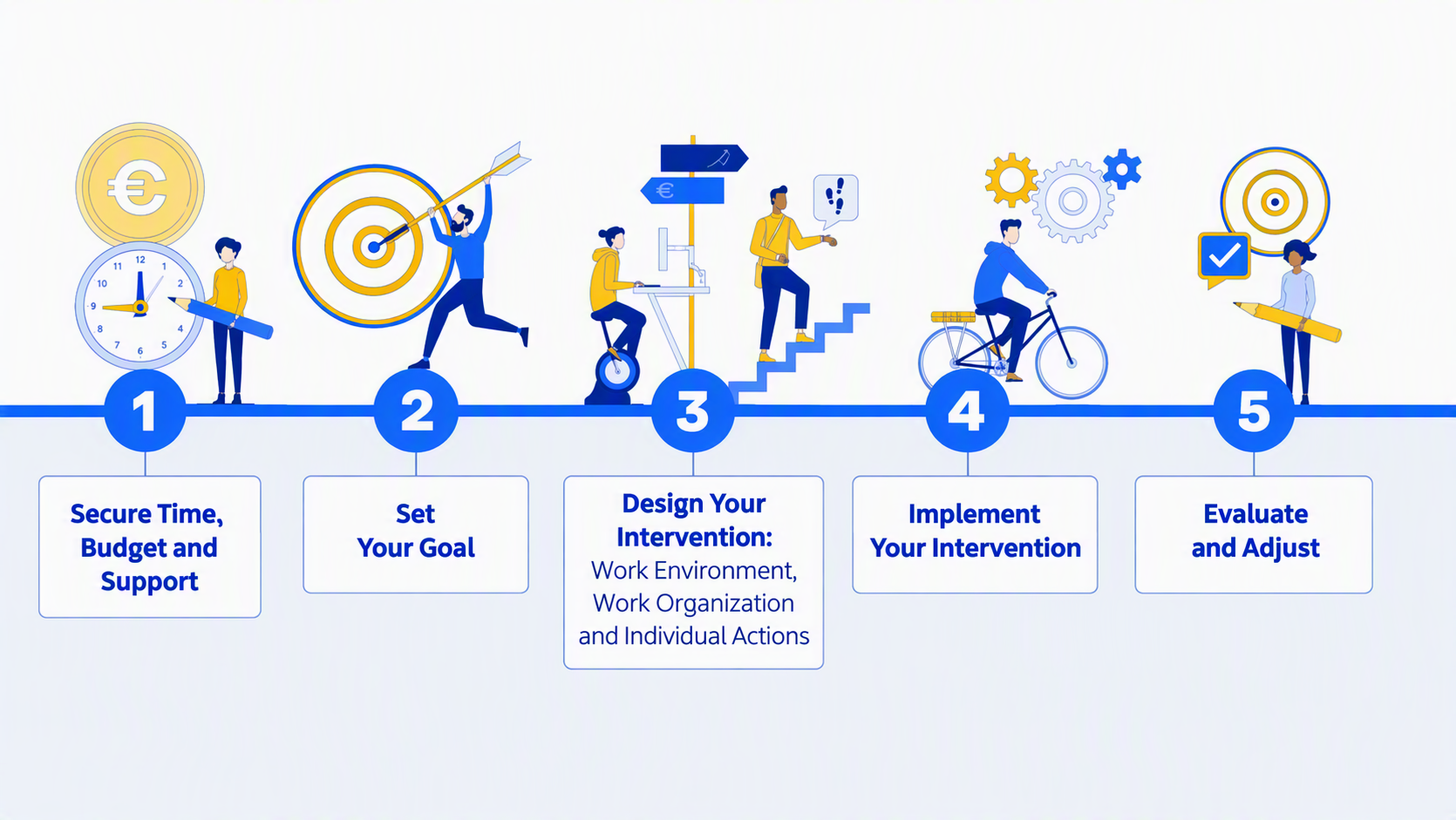
Step 1: Secure Time, Budget and Support
Budget and Finances
Determine, together with the person responsible within the organization, what budget is available to develop the intervention. It can be helpful to prepare a budget plan. Purchasing new furniture is often the largest expense.
Budget decisions can also be made in stages. Initially, funding may be allocated only for an exploratory phase, providing a basis for further decisions at a later stage. Aligning the intervention with other projects, such as office renovations or relocations, may help reduce costs.
In addition, tax schemes such as the Dutch Work-Related Costs Scheme (WKR) can allow employers to provide certain products and services to employees tax-free, within the applicable allowance. Examples include reimbursements for home-office equipment or providing employees with a company bicycle.
Roles, Responsibility and Time
Establish a clear division of roles and responsibilities and involve the relevant roles from the outset, such as management, HR, communications, occupational health and safety professionals, prevention officers, and facilities staff. Agree on who is responsible for which tasks and ensure that those responsible have sufficient time to carry them out, such as preparing the budget, selecting suitable furniture, and putting together the intervention. Make communication arrangements at an early stage as well, for example by agreeing on a clear overarching theme or campaign title, a communication calendar, and regular repetition of key information. In addition, it is important that, once the intervention is implemented, employees are given and feel they have sufficient time and opportunity to make use of it.
Engaging Management
It is important to have the support of management or organizational leadership for plans to reduce sitting and increase movement during the workday. Management support is essential because managers can allocate budget, give employees the time and opportunity to participate, and help promote the initiative throughout the organization.
Prolonged sitting can, for example, be brought to management’s attention through a Risk Assessment and Evaluation (RI&E). An RI&E is mandatory for almost all organizations in the Netherlands. Employers have a duty of care to provide a work environment that is as healthy and safe as possible. To support employees’ health and vitality, the risks associated with prolonged sitting should therefore be considered as part of the RI&E, with appropriate measures included in the action plan.
An active culture at the workplace, aimed at reducing sitting and increasing movement at work, can be incorporated into a broader health and well-being policy that also addresses topics such as healthy eating and workload. To gain management support, it is important to connect the policy to issues that are relevant to the organization. For example, how could a workplace physical activity policy contribute to issues such as employee turnover, productivity, sickness absence, and job satisfaction?
Below is an example email that can be used to explain the importance of a workplace physical activity intervention to management.
Engaging Employees
Building support for the new intervention and ensuring that it meets employees’ needs are important for increasing its acceptance and use. Therefore, employees should be involved at an early stage in designing and implementing the intervention. Employees are familiar with their work processes and any challenges they encounter, and can therefore provide valuable input on what is needed and what does or does not work to encourage more movement and less sitting in the workplace.
Forming a Project Group
Which employees, and which representatives from management, are willing to take responsibility, act as role models, or test the intervention beforehand? Aim for a project group that reflects the workforce and includes both enthusiastic and less enthusiastic employees. Employees who are already familiar with the topic and consider working on their health important may be more likely to participate enthusiastically.
A project group should consist of 3 to 10 members. Define the responsibilities of each member and involve the project group in important steps and decision-making, such as setting the goal (Step 2), designing the intervention (Steps 3a–c), implementing it (Step 4), and evaluating and adjusting it (Step 5).
Through their involvement in the project, these employees can naturally become ambassadors and play a role in informing and motivating their colleagues (see also Step 4). Also involve the project group in assessing how much time employees spend sitting and what solutions employees themselves suggest for reducing sitting and increasing movement.
Assessing Sitting Time and Employees’ Needs
Employees’ needs can be assessed in several ways. Information can be gathered through the project group, or a short questionnaire can be distributed, for example as part of or alongside an employee satisfaction survey, the Risk Assessment and Evaluation (RI&E), or a preventive medical examination (PMO).
In general, the aim is to understand how much time employees spend sitting and what solutions they themselves suggest for reducing sitting and increasing movement.
Step 2: Set Your Goal
The aim of a project to reduce sitting and move more at work is ultimately to change behavior. Changing behavior can be challenging and requires patience and persistence. The goal is to break established patterns of prolonged sitting at work and replace them with more active habits.
Setting a clear and measurable goal helps you select the right components for the intervention (Step 3) and ultimately change employees’ behavior. Ideally, involve the project group in setting the goal. Examples of clear and measurable goals include:
- Employees take the stairs more often.
- Employees spend one hour less sitting per workday.
- Employees take 2,000 more steps per day.
- More employees cycle to work.
- Employees feel more energetic and/or healthier.
Progress towards the goals can be measured using questionnaires, for example as part of employee satisfaction surveys, Risk Assessment and Evaluations (RI&Es), or preventive medical examinations (PMOs) (see the questionnaire on sitting time and the need for workplace physical activity interventions), or by using step counters. Employees can also be asked directly about progress, for example during team meetings. Measuring whether the goal has been achieved is not mandatory. Even without formal measurements, it is important to set a clear movement or behavioral goal, as this helps in selecting the right active ingredients to reduce sitting and increase movement.
Step 3: Design your intervention
There are three types of measures to encourage employees to sit less and move more in the office:
a. Adapt the work environment
b. Organize work differently
c. Individual action
Use a Combination of Measures
To increase the effectiveness of an intervention, it is important to include a range of relevant measures. For each of the three types, select the measures that best fit your organization and the goal set in Step 2, and involve the project group in your choices.
Some measures have a greater impact than others, while some need to be combined with information for employees on how to use them effectively. Ask employees how they would like to receive information and consider which communication methods have worked well in the past.
Bring the Measures Together into One Recognizable Program
Combine measures from the three types into one coherent approach. Employees do not need to see them as separate measures. For example, bring them together in a campaign built around one recognizable theme. Behind the scenes, the employer deliberately selects and combines the measures needed to achieve the goal.
Office and Work Environment
- Sit-stand desks & desk bikes: Encourage employees to alternate between sitting, standing, and moving by providing ergonomic meeting and workspaces, such as sit-stand desks, desk bikes, or standing areas for short meetings. Use reminders, varying their format and message, to encourage employees to use these facilities, for example stickers or tabletop signs.
*Please note: variation is important. Encourage employees to regularly interrupt sitting with light physical activity, and limit standing to no more than 1 hour at a time and no more than 4 hours per day.
Download instructions for setting up your office workstation, including how to use a sit-stand desk (NL)
Visual cues & posters: Make opportunities and tips for movement visible by displaying posters with simple exercises and providing downloadable movement tips. For example, place inspiring posters and motivational messages in stairwells to encourage employees to take the stairs instead of the elevator.
Download the template and simply add your company logo - Exercise facilities: Provide a space with basic exercise equipment, such as weights, yoga mats, or a stationary bike, so employees can be physically active during the workday.
- Facilities for active commuting: Encourage active commuting by providing appropriate on-site facilities, such as spacious and secure bicycle parking with sufficient charging points for e-bikes, showers and changing rooms, and lockers.
During Work
- Task rotation: Ensure sufficient variation in tasks to encourage different working postures and movement and to avoid prolonged static postures.
- 50-minute meetings: Schedule meetings for 50 minutes instead of 60 minutes, or 25 minutes instead of 30 minutes, to leave time for movement and a short break. This can easily be set as the default in your Outlook calendar. See how to do this in Microsoft and Google.
- Guidelines for active meetings: Introduce guidelines for more active meetings, such as holding standing meetings or including short movement breaks during longer meetings.
- Walking meetings: Replace regular meetings with walking meetings, either by walking together or by having participants join a call using headphones while walking. You can also add a walking route, such as “Walking Route 1,” as a meeting location. The route can be mapped out around the workplace or an existing route can be used. See also the Weetings website for walking routes and tips for walking meetings(NL)
Between Work Activities
- Workshops: Offer workshops on the benefits of sitting less and moving more, including practical tips that employees can apply during the workday.
Read a practical example of using workshops (NL) - Group activities and challenges: Organize accessible group activities and challenges, such as group walks, yoga sessions, stair-climbing challenges, or step challenges, to encourage employees to move more. There may also be colleagues who would enjoy leading an exercise session before, during, or after work.
- Walk-friendly lunches: Encourage employees to move during their lunch break by making it easier to have lunch while walking. For example, providing packed lunches or lunch bags can help facilitate this.
During the Commute
- Schemes to encourage active commuting: Encourage employees to commute actively by offering schemes that enable them to purchase a bicycle or e-bike at a reduced cost, or by providing a cycling allowance or lease bikes.
Read more about different schemes and options for your organization (NL)
Read a practical example of how to encourage active commuting (NL)
- Personal activity plan / one-to-one sessions with an occupational physiotherapist or coach: Give employees the opportunity to develop a personal activity plan together with a physiotherapist or coach, tailored to their work routine and physical activity patterns.
- Set personal activity goals: Encourage employees to set an achievable goal, possibly together with a coach, such as standing up every hour, taking 8,000 steps a day, or taking the stairs instead of the elevator.
- Use break software or movement reminders: Encourage employees to set reminders on their phone, smartwatch, or computer to regularly change posture or take a short movement break.
- Set up an ergonomic workstation: Ensure that each employee’s office chair, desk, and monitor are properly adjusted and that employees know how to make these adjustments themselves. Information and instructions should also cover how to adjust and use a sit-stand desk and the importance of regularly changing posture.
- Employee tool: Employees can complete the TNO Sit Less and Move More at Work Checklist to become more aware of their own sitting and movement behavior and receive practical tips.
- Schemes to encourage exercise: Encourage employees to exercise by providing financial support, such as discounts on gym memberships, a fitness allowance, or company fitness programs.
- Online platform: Set up an online platform where employees can find relevant information about health, well-being, and physical activity at work.
View a practical example of an online health and well-being platform (NL)
Step 4: Implement your Intervention
Bringing the Measures Together into One Intervention
Once the measures have been selected, they can be brought together into a single intervention and implemented. Informing and motivating employees is essential to ensure that they are aware of the intervention and make use of the different measures available. Seeing colleagues participate can also encourage employees to get involved. Being active is more enjoyable when you do it together.
To encourage employees to sit less and move more at work, simply changing the work environment or reorganizing work processes is not enough. Employees also need to understand the importance of movement and be motivated to change their behavior. Ongoing awareness and encouragement can help create a workplace culture in which movement during the workday becomes the norm. This requires targeted communication and support, such as regularly highlighting the topic and the available measures in newsletters and team meetings
Management as example
Employees may think that stepping away from their desks more often will make them less productive and that management may not support this. However, research shows that taking several short breaks to move does not negatively affect productivity. Management plays an important role in leading by example and encouraging employees, so that employees feel comfortable doing the same.
Download practical tips for managers
Appoint Health Champions / Ambassadors
Enthusiastic colleagues who are already physically active can act as role models and encourage others to become more active. These could also be members of the project group (see Step 1).
Encourage Employees to Move Together
Doing activities together can make movement easier and more enjoyable. Take the stairs together, join a workshop together, or go for a lunchtime walk with colleagues. Encourage employees to be active together and include this message in your communication.
Good planning is essential when implementing the intervention. When and how will the intervention begin? Are there other internal initiatives, such as a health and well-being week, that the intervention could tie in with? When will the different parts of the intervention be introduced, and how can they best be coordinated? An office renovation or relocation may provide a good opportunity to create a more movement-friendly workplace and build momentum.
Key considerations when planning and organizing the implementation include:
- Purchasing equipment: Allow sufficient time to request quotations and take furniture delivery times into account.
- Adapting work organization: Assign specific actions to specific people. It is important to document workplace physical activity policies, but also to ensure that changes to the way work is organized are actually implemented in practice.
- Plan when those involved in delivering the intervention, such as trainers, coaches, or managers, will be needed. Consider:
- The order in which information and activities are introduced: for example, should managers be informed first, or should individual coaching start first?
- The intensity of the program: for example, the number of sessions or activities and the duration of each session or workshop.
- Keeping employees engaged throughout the implementation of the intervention.
- Informing and motivating employees: these are important parts of implementation and should also be planned, with clear responsibilities assigned.
Embedding the intervention in the organization is important to ensure that its effects become a lasting part of the organizational culture.
Consider the statements below. Do they apply to the intervention in your organization?
- Key people within the organization lead by example when it comes to sitting less and moving more.
- Sitting less and moving more is a regular agenda item in team meetings.
- Senior management and/or managers remain involved in the intervention to encourage employees to sit less and move more.
- Employees are regularly kept informed about how the different measures to reduce sitting and increase movement are progressing.
- Progress towards the intended goals (Step 2) is measured and the results are shared.
- New employees receive information and guidance on how the organization puts sitting less and moving more into practice.
- Someone remains responsible for the intervention.
- Refresh activities are organized from time to time to renew interest and engagement.
- Successes are celebrated.
Step 5: Evaluate and Adjust
Evaluate whether implementing the intervention has achieved the intended goal and whether the intervention was implemented as planned.
The intervention is successful if…
- …the goal set in Step 2 is achieved, for example: employees take 2,000 more steps per day, spend less time sitting, more employees cycle to work, or employees are satisfied with the intervention.
- …the intervention reaches the target group, for example: employees use the available furniture, organize shorter or walking meetings, and are aware of the benefits of moving more.
The intervention has been implemented successfully if…
- …it has been implemented as intended, and those involved and the employees are satisfied with the measures and how they were implemented.
Measuring progress towards the goals is discussed in Step 2. Measurement can also be incorporated into the intervention itself, for example by using step counters or by holding a motivating group or individual discussion about the purpose and value of the intervention.
Evaluation and adjustments do not have to wait until after implementation. You can already evaluate and make adjustments while the intervention is being implemented. Assess the extent to which the goals are being achieved and discuss progress with the ambassadors. What do they need to better inform and motivate other employees?
Continue to evaluate regularly, for example during or after activities that draw attention to the topic or following a refresh activity. This helps maintain ongoing attention and embed sitting less and moving more into the organizational culture.